1.1
Evaluate the key elements of historic horticultural spaces from the
14th to 21st Centuries history including:
1.1.1
Medieval Gardens – key features include:
- Enclosures:
Wattle fences, thorn hedges.
- Structures: Trellis arbours, covered walkways (linking
buildings).
- Planting: Grass as "flowery meads" with wildflowers, herbs
for scent/medicine.
- Features: Turf seats, simple water features.
Introduction
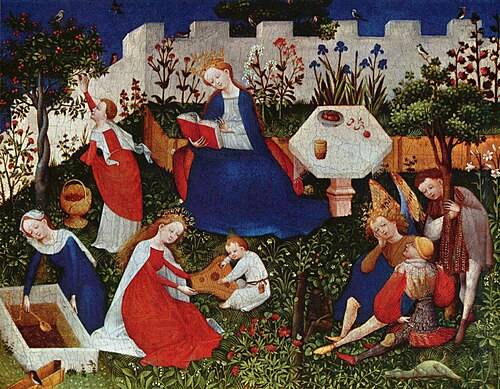 Paradise Garden, with the Virgin, child
Jesus, and saints, 1410s, Rhineland
With
regard to gardening, the Medieval Garden refers to the time period
spanning from the 5th Century to the late 15th Century (in European
history from the fall of the Western Roman Empire through to the
beginnings of the Renaissance).
Very little is known of
western gardens from the time of Sidonuis Apollonarious (430AD) to
Charlemagne (768AD), beyond this point three documents appear in the
historic record which provide an outline of garden practice at the
time. First around 795 there are 73 plants and fruit-trees listed which
must be grown in the Capitulare de villis vel curtis imperii
(regulations for the administration of the towns in Charlemagne's
empire). The second is a plan of a monastery and related buildings from
816 for the monastery of St Gall, Switzerland. It is unclear if the
plan
is 'real' or 'ideal', however it is incredibly detailed with three
separate gardens indicated. All are rectangular and situated within the
external boundary wall, each with a particular purpose. The herbularius
(or physic garden) is next to the infirmary and has sixteen separate
beds, each for a different plant. The second is the hortus (or
vegetable garden) which has eight beds set out in two rows of nine,
each for a different plant. The third garden has a double function: it
contains thirteen trees, mostly fruit trees which are spaced evenly
among the graves of monks. The third is the poem Liber de cultura
hortorum (commonly referred to as the Hortulus) written by the monk
Walafrid Strabo (809-49AD) it begins with general remarks about the
life of a gardener, describing the making of a small garden from
scratch, growing vegetables in raised beds, planting from seed and
taking an propagating cuttings ending with 22 sections describing the
appearance, qualities and uses of plants which he grows.
Towards the end of the Medieval period which this part of the RHS
syllabus is concerned with (particularly the 14th and 15th centuries)
medieval society was strongly influenced by Christianity,
feudalism and social hierarchy. Gardens were generally associated
with monasteries, castles, manor houses and wealthy households
rather than being public spaces. Gardens had a combination
of practical, religious, social and aesthetic functions. They
could provide food, herbs and medicine, but also places for
contemplation, recreation, privacy and displaying wealth.
Other common elements of a medieval garden include:
Alley or tunnel
Tunnels of fruit trees, vines or roses, trained on wooden frames,
provided shady walks for exercise and blossom and fruit in season.
Estrade
Shapes made of wood over which plants were trained were used in gardens
as if they were living topiary pieces. A typical estrade would be a
series of concentric circles trained in tiers, the size decreasing with
height.
Flowery mead
An idealized meadow of flowers portrayed in contemporary manuscripts,
tapestries and as a foreground in religious paintings. By the end of
the 15th century the flowers were painted more naturalistically and
could be identified.
Fountain
As in the Muslim garden, water, the symbolic fount of life, was an
essential element and fountains, placed in the centre of small enclosed
gardens, assumed increasingly elaborate Gothic shapes.
Gloriette
A word of Spanish origin used to describe a pavilion, usually placed at
the centre of a garden to mark the intersection of pathways or avenues.
In the Middle Ages the gloriette
often provided accommodation.
Raised bed
While in desert countries flowerbeds were sunken for irrigation
purposes, in the wetter climate of northern Europe, raised beds,
surrounded by boards or woven willow as already suggested in the Roman
manuals, improved drainage.
Trelliswork
Built with strips of hazel or willow, trelliswork for fences or arbours
on which roses could be grown was a feature throughout the Middle Ages.
Turf bench
Often seen in medieval illustrations, the bench’s frame of stout
willow, or even brick, was packed with soil in which grass or scented
herbs were grown. Pietro de’ Crescenzi recommended using sods of turf
rather than sowing grass seed.
Viridarium
From the Latin, the word was originally used for a plantation of trees.
In late medieval times it was applied to the pleasure garden or orchard
as distinct from the more useful herbularis.
Hobhouse, P. (2002) The story of gardening. DK - Pg 102
1.1.1.1
Enclosures: Wattle fences, thorn hedges.
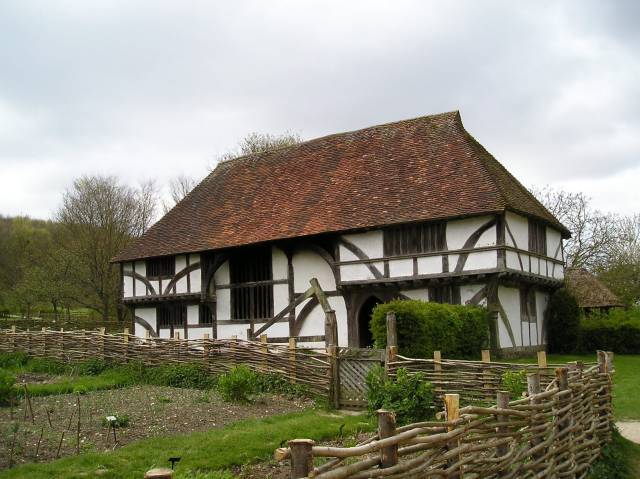 Weald and Downland Museum, Sussex
A particularly important concept is the enclosed garden,
or hortus conclusus. Enclosure had both a practical function
and a strong Christian symbolism, representing purity and the Virgin
Mary. Medieval gardens were typically square or rectangular, shaped by
the cloisters of religious buildings. To Christians, a walled garden
held deep meaning-it symbolized the Virgin Mary, inspired by the virgin
bride of Solomon's Song of Songs: "A garden enclosed is my
sister, my
spouse; a spring shut up, a fountain sealed." In medieval art, Mary is
often shown in a garden surrounded by walls, fences, or palings, with
the enclosure itself emphasized as a key detail.
Even
outside religious settings, walls were essential. Gardens were usually
square or rectangular, or made up of rectangular sections, fitting
neatly alongside the rectangular town houses. Kings' gardens were no
exception; they were also meant to be "enclosed with high
walls" as
advised by the Petrus de Crescentiis in 1305, one of the earliest
detailed accounts of garden design after Walafrid. Inside these walls,
gardens were further divided into symmetrical, geometric sections;
square beds or rectangular plots, connected by cross-paths. This
structured, enclosed layout, tied to the architecture of the home,
became the foundation for all formal European gardens that followed,
later reinforced by the influence of the Persian foursquare
garden
design.
Recommended Reading


 Campbell,
G. (2016) A short
history of gardens. Oxford University Press - Pg 16 - 18
Hobhouse,
P. (2002) The story of
gardening. DK - Pg 102
Recommended Viewing
 ASE's
Medieval Garden 1 - Introduction
ASE's
Medieval Garden 2 - Cuisine and cures
ASE's
Medieval Garden 3 - Weeds and foraging
ASE's
Medieval Garden 4 - Flowers and reflections
Michael
Brown and Medieval Gardens
Useful
Websites
 Medieval Gardens - The Gardens Trust
Garden design through the ages - National
Trust